
Route
The building
The house does not offer many distinctions compared to the other buildings located in its surroundings. It is located in the town center, in the Cup Square, where several taverns were located, a total of 5 documented at the beginning of the century. It is a traditional house of the Safor region. It is a two-story house, with two bodies and an enclosed courtyard. The ground floor has a central hallway and three naves, and the upper floor is an open space.
Living spaces
The living space groups together the places in the house where the social and vital relationships of the individuals who lived there take place, differentiating it from those related to or linked to the production process inherent in the quarry industry. All of these spaces are located on the ground floor of the building.
The bedroom
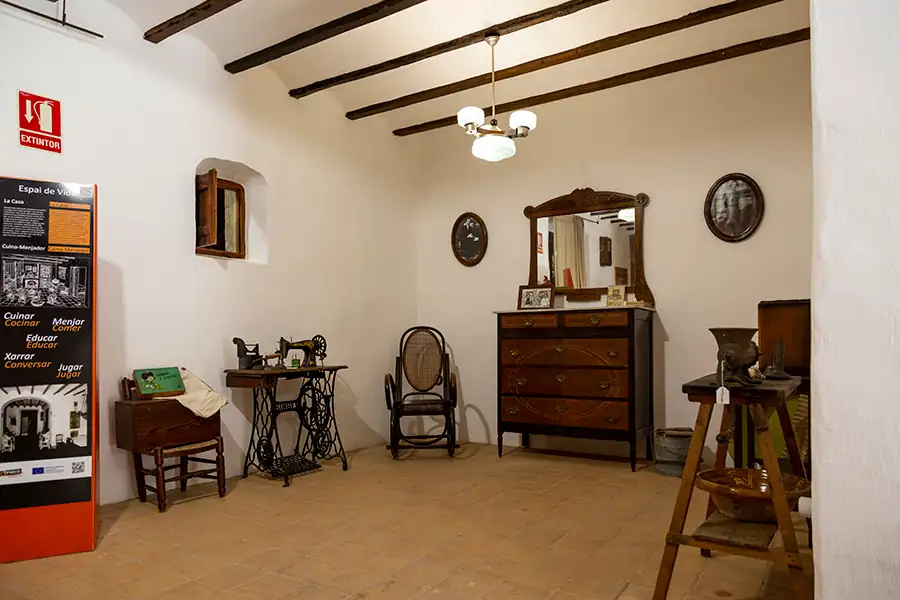
In the first corner, on the right hand side, was one of the bedrooms of the house. It is the most intimate place for the inhabitants of the house; private activities such as addressing themselves, resting or sleeping took place in the warmth of this space. This first exhibition unit recreates a alcove-style room, with the elements that are typical of it (furniture, objects, clothing, etc.).
Dining room - Living room
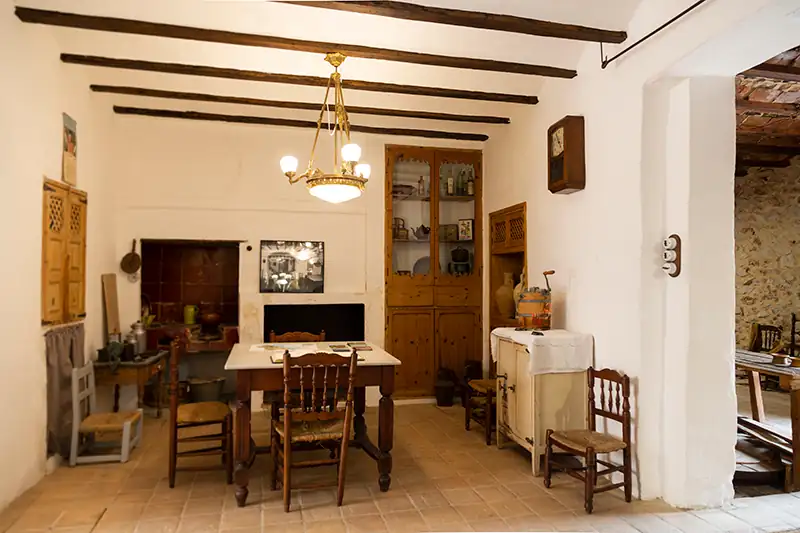
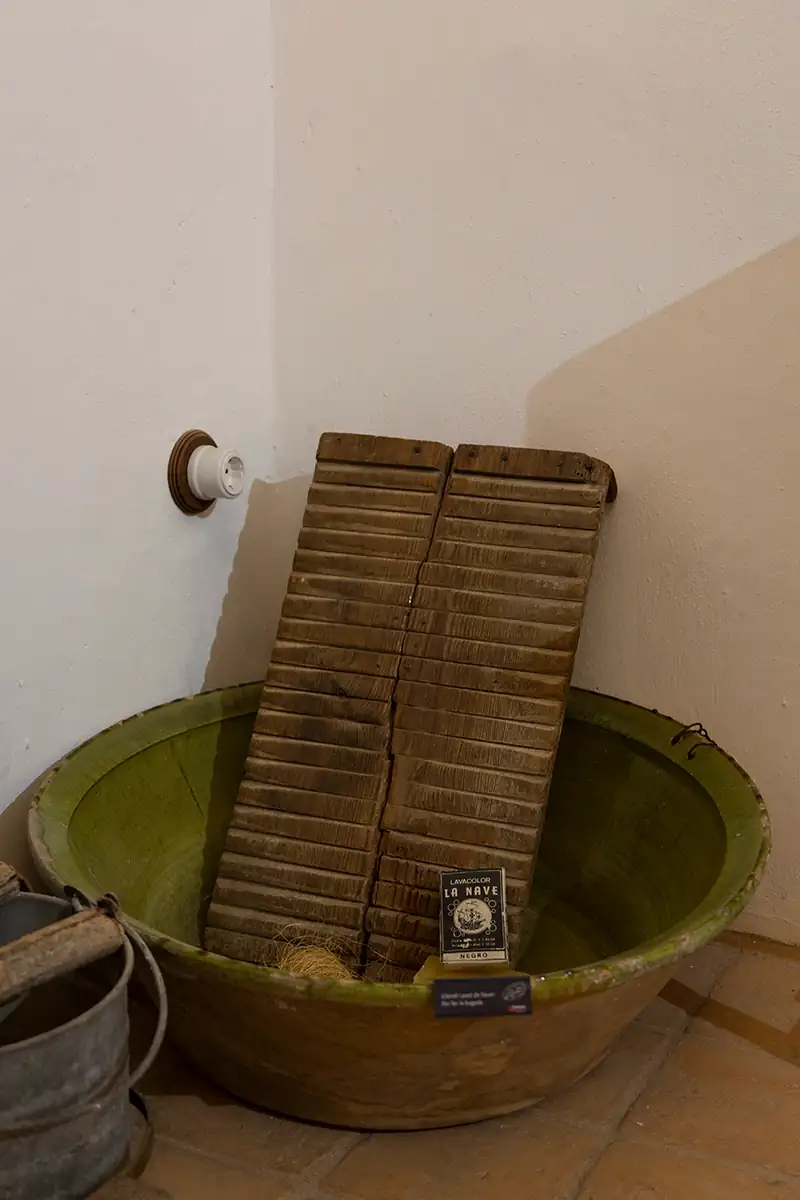
In the second wing we find the dining kitchen, with the immovable elements restored to their original state, such as the fireplace, the kitchen, the cupboards in the pantry or the laundry room; which, along with the furniture, tools and objects, allow us to recreate the atmosphere of the most vital room in the house. But it also allows us to relive it, around a cozy table and the fire of the hearth.
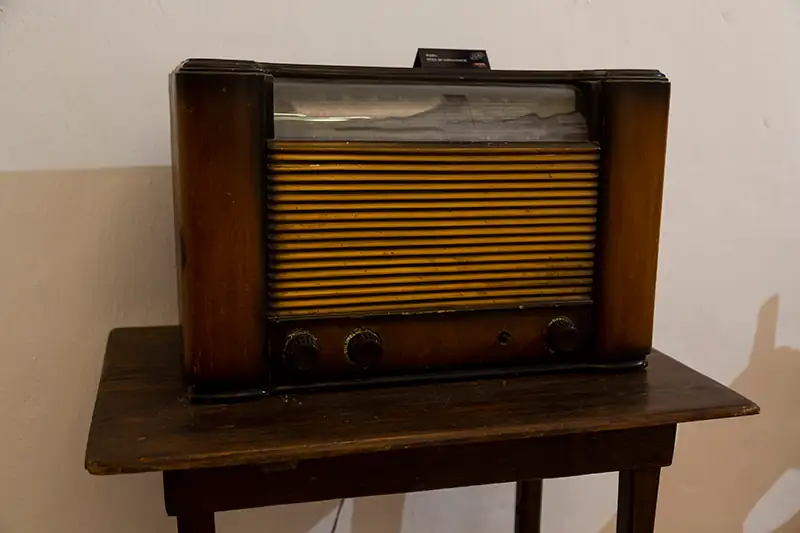
In the space located in front, there are furniture and objects related to domestic life, with the forms of social relationships typical of the territorial context in which we live.
Craft space
The third wing and the upper floor, together with the courtyard and the adjacent outbuildings, constitute the artisan sector of the building. We preserve immovable elements related to the production process, which have been restored and exhibited alongside the tools and other objects typical of the pottery craft.
The workshop
It occupies the entire third corner of the house and houses a set of devices and tools that, after being restored, are part of the permanent exhibition. Most of them are immovable elements, such as the bench and stool, the electric bench, the electric motor and the transmissions, or the electric varnish mill, but there are also other furniture elements used in the workshop tasks, such as the clay-mixer, or various tools for gardening (turning plates, sieves, cutting wires, sticks…). Furthermore, the original electrical installation is preserved. In this area, a significant part of the pottery work was carried out: the shaping of the pieces from the clay.
The deposit of mud
The clay deposit served to store the clay once it was created; it was stored in a room that had humidity conditions to prevent it from drying out and to allow it to be worked when Angel needed it. The deposit has a window that connects directly to the courtyard so that the clay could be passed through this space. However, not an entire piece of clay was deposited; rather, it was separated into layers between which wet straw bags were placed.
The sedimentation pond
In the decanting ponds was where the manufacture of the brickmaking process began. When the earth reached the factory, impurities were removed, especially stones. The mud to be used had to be as flexible as possible. This process was carried out in the decanting ponds, which were generally at least two rectangular structures made of masonry, of different depths and connected to the industry by annexes.
In one of the ponds, the highest one, the soil is mixed with the water; the resulting product is poured into the other pond through a conduit where a skimmer is located that removes the larger impurities. In the second pond, the liquid is left to settle so that the heavier rocks or pebbles would settle to the bottom; once the excess water is removed, what is called the mud flower remains at the top; this is the ideal and most valuable material for the work of the potter. This mud is stored in the mud deposit.
The carpenter
In the courtyard we find a covered area that was once used to store the firewood for the oven, in addition to other bulky objects such as benches and wooden posts for drying the garments. Next to the wood shed was the granary, and both the supply of firewood and the supply of land were done with donkeys from the fields and the mountain.
The oven
The oven is located in another covered area at the bottom of the courtyard. A key element of the production process, it is the place where the fire, and more specifically the heat, transforms a soft and weak object of clay into another more hard and consistent one, the terracotta.
This oven is of vertical firing, also known as a “morú”. It is built with solid tiles, has a thin masonry wall and lime mortar on the front part, and two clearly distinct parts, connected to the outside by a staircase.
The fireplace chamber, located at the bottom, is a rectangular space covered with a perforated barrel vault, and with a small opening at the end through which the wood was inserted to light the fire. Above it is the cooking chamber, a smaller space, circular and covered with a perforated dome where, through an opening, the claywork for cooking was deposited. The floor features peripheral holes that served to let the heat pass through, and is called ’grill“. These two levels are connected to the outside by a stone staircase.
The pieces were arranged inside the oven; this was a measured task where the arrangement was not arbitrary at all. After closing the opening of the baking chamber, the flame was lit in the fire chamber, and from then on bundles of firewood were continuously being inserted. A baking oven could last between 25 and 32 hours, plus a couple of days had to be waited for in order to open the oven.
The production
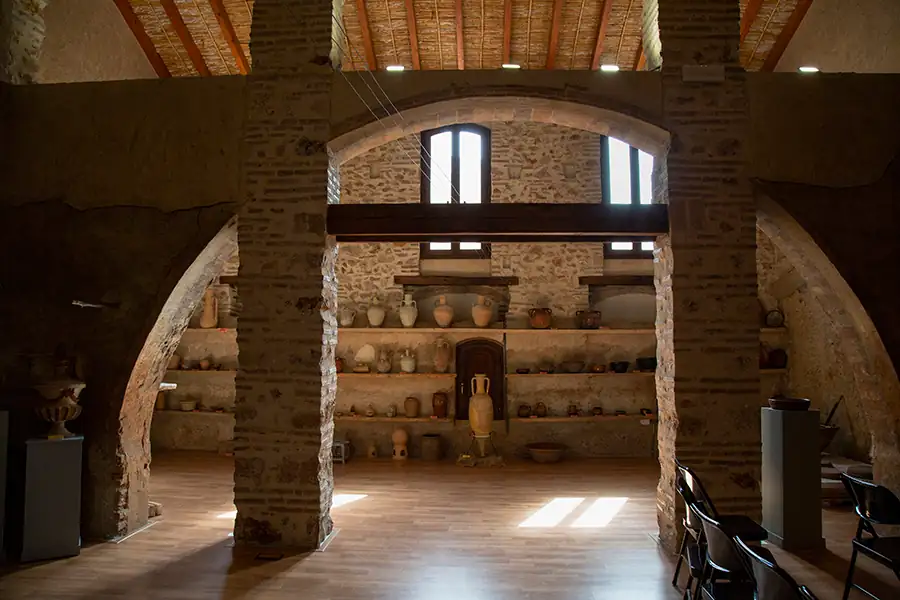
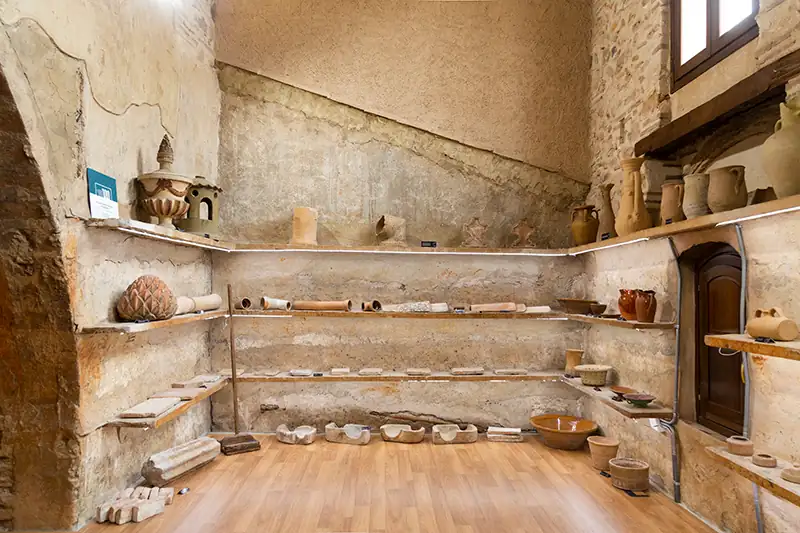
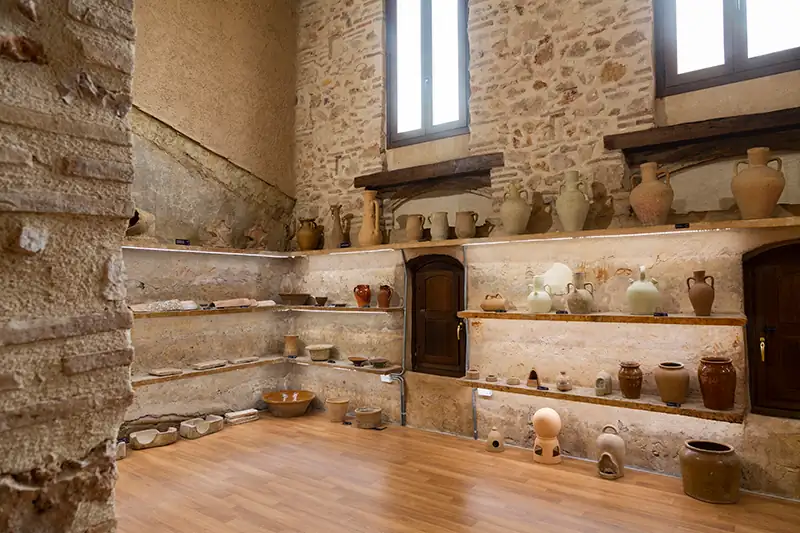
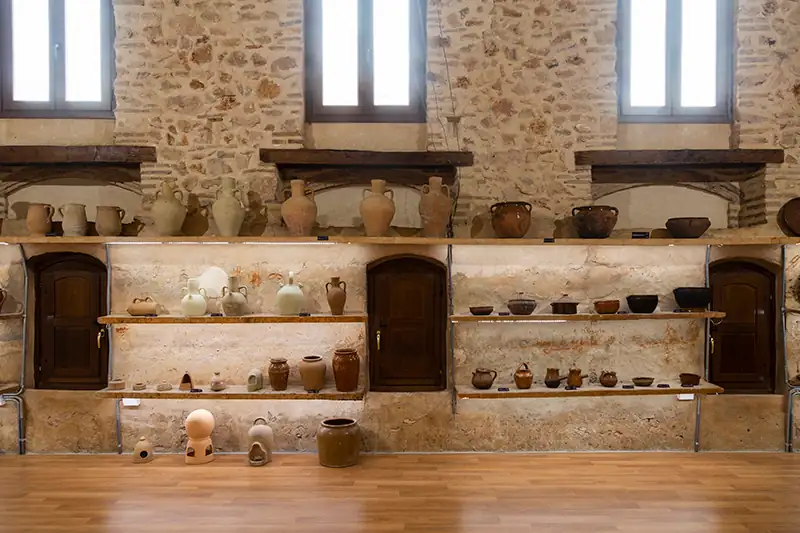
In the first floor of the upper part of the house, we have installed a sample of the pottery production from Potries, both of construction elements and of stoneware products for household tools, highlighting above all the pottery production. These pieces are dated to the 19th and 20th centuries.
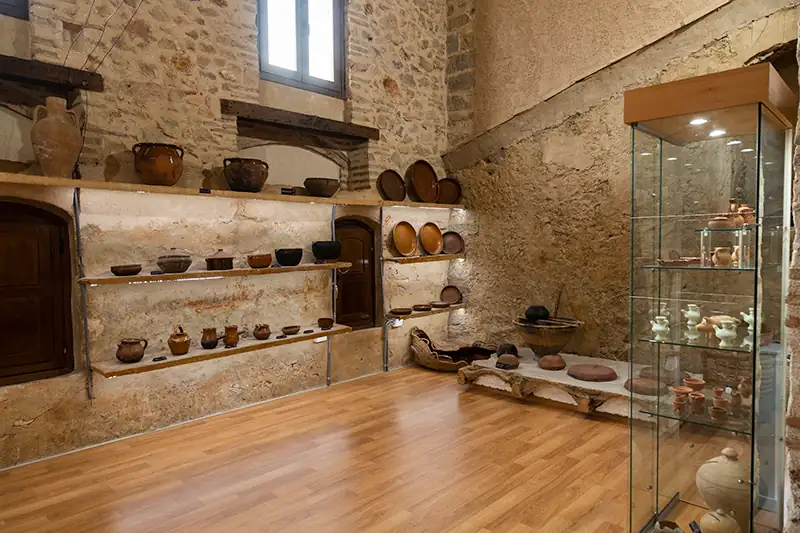
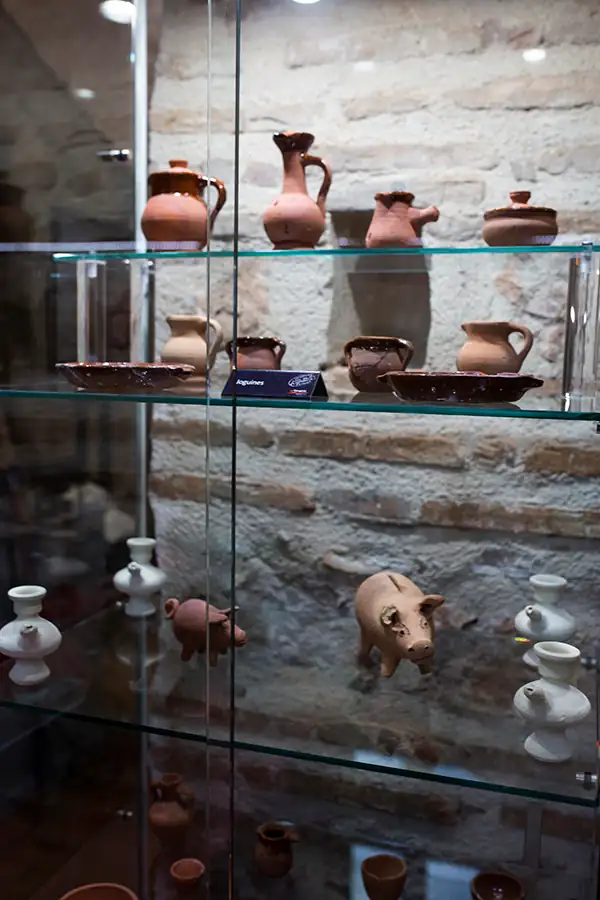
You can see a village of terraced houses
Potries has throughout the centuries constituted a center of ceramic production and an important nucleus of pottery activity; the very name of Potries has its origin and meaning in this artisanal profession. On the other side of the upper floor we can travel through the centuries, hand in hand with a thousand-year-old artisanal craft: the pottery production in Potries. We can admire different aspects related to the manufacture of local pottery objects from different historical periods. In other words, we will use pottery and its products as a guiding thread for a suggestive journey through the history of the potters and potters themselves, and by extension of the inhabitants of La Safor and the Valencian Community.
First settlers
It is very likely that the origins of pottery in Potries date back to the Neolithic period, a fact confirmed by the existence of an archaeological site from this era in the “Penyascos” mountain and an associated necropolis located on the plain near the Serpis river, with a chronology dating from between 3000 and 1500 BC.
We also conserve some Iberian ceramic pieces, found in Potries, specifically fragments of vessels and some fusaioles.
The Roman villa
It is very likely that the origins of pottery in Potries date back to the Neolithic period, a fact confirmed by the existence of an archaeological site from this era in the “Penyascos” mountain and an associated necropolis located on the plain near the Serpis river, with a chronology dating from between 3000 and 1500 BC.
We also conserve some Iberian ceramic pieces, found in Potries, specifically fragments of vessels and some fusaioles.
Medieval and modern production The master's forge
With the arrival of Islamic civilization in the 8th century AD, the expansion of a technique also originating from the Orient took place. Although previously known, this technique was not widely used; we are referring to vitrification. Vitrification uses mineral oxides that acquire vitreous characteristics at high temperatures. Applying oxides to a ceramic object guarantees its impermeability, fulfilling a dual function: hygienic and decorative. In the Valencian lands, ceramic production received the contribution of all these cultures. However, it was the Andalusian period that provided us with a vast repertoire of techniques, forms, and decorations that would decisively influence the magnificent ceramic productions of the Low Middle Ages in Valencia, which, until the 16th century, would be exported throughout Europe, and where the emblematic centers of Paterna and Manises stand out.
In parallel to the Valencian context, there were also other production centers, but of a more restricted scope, such as Potries, where the pottery workshops were influenced by the feudal power, and they produced common pottery glazed or varnished (pots, casseroles, jars, basins, pitchers, pots, etc.), and another very unique and characteristic feature of this production center were the so-called sugar forms, which were the clay containers used to refine the sugar produced in the Safor region.
During the Low Middle Ages, Potries and other settlements constituted, from the 13th century onwards, the territory of the Barony of Rebollet, and later, in the 15th century, became a fundamental part of the County of Oliva. The Carrós lineages, the Riusech And from Centelles, they possessed the lordship of this fertile enclave, where the sugar cane provided wealth and splendor. At the end of the 16th century, the destiny of the County changed; from then on it became a more powerful state of the powerful Borja family, holders of titles among other things of the Duchy of Gandia.
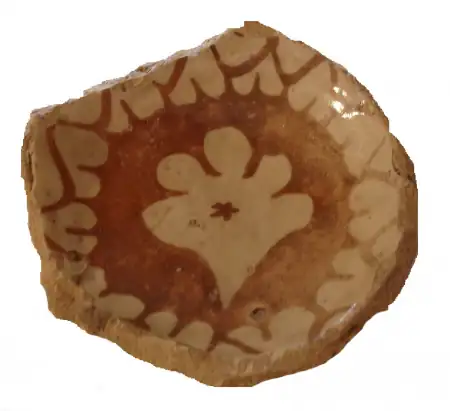
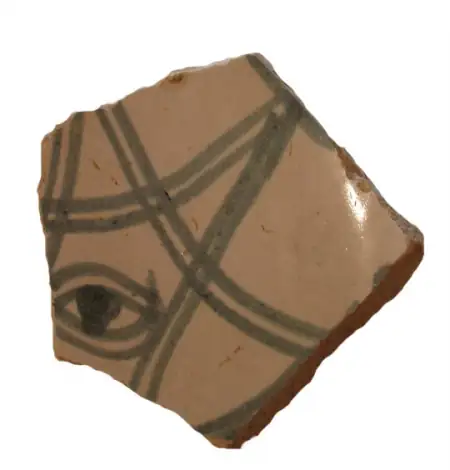
Discoveries of ceramic waste dumps in the Avenue de la Constitution (formerly Barranc Street) as well as in the street of Sant Joan Baptista in Potries bear witness to the joint production of fire and table ceramics, with glazed covers, of common and painted ceramics, as well as sugar and porron shapes to supply the factories for processing and refining the sugar cane in the region. The types and techniques used point to a consolidated and characteristic production between the second half of the 16th century and the first half of the 17th century. All this has been corroborated after the very interesting emergency excavation carried out in San Salvador Street in 2000, just in the space occupied by the former sugar mill of the gentleman. A kiln was excavated and two more were documented.
The Terrissaire Families of Potries
The pottery workshops are the most characteristic and defining clay-processing centers in Potries. Despite the uncertain origin of the production of fired ceramic products, which would have to be dated back to the XVth or XVIth centuries, it is in the mid-19th century that they are established and integrated into the urban topography of Potries. Their peak moment will be the first third of the 20th century.
Their location is, in all cases, the historical center of Potries. They present a certain clustering at both ends of the town, given their character of a polluted industry that generates dirt and smoke.
The pottery and the structure of the work itself are linked to a single-family cell, although the kilns are sometimes shared by several production units. The Tarrazó, Domínguez, Faus and Canet families, among others, are the most representative of this artisanal activity, which requires a certain degree of specialization by the artisan and other components of the family nucleus.
1. Carrer de Boamit, No. 17
- Joaquín Faus Cabanilles (1842- ?)
- Salvador Faus Cabanilles (1846-1910)
- Pere Vicent Faus Moratal (1871-1954)
2. Calle Del Cup (Del Olmo), No. 4
- Salvador Domínguez Fuster
- Simeón Tarrazó Morant (1864-1896)
- Simeón Tarrazó Domínguez (1889-1949)
- Salvador Tarrazó Martí (1930- )
3. Calle Del Cup (Del Olmo), No. 6
- Eduardo Domínguez Fuster in Activity in 1838
- Antonio Vicente Domínguez Fuster (1831-1908)
- Eduardo Domínguez Fuster (1842- ?)
- Ángel Domínguez Fuster (1873-1930)
- Ángel Domínguez Ortolà (1903-1986)
4. Calle Del Cup (Del Olmo), No. 8
- Juan Bautista Domínguez Moreno (1867- ?)
- Fernando Domínguez Domínguez (1898-1967)
5. Calle Del Cup (Del Olmo), No. 16
- Joan Baptista Canet Bataller (1865- ?)
- Joan Baptista Canet Domínguez (1903-?)
6. Plaza del País Valencià, No. 3
- Enrique Domínguez Moratal
- Francisco Domínguez Peiró (1859- ?)
- Manuel Domínguez Peiró (1861-?)
- Francisco Domínguez Soler (1891- ?)
7. Calle De Sant Salvador, No. 8
- Tomás Domínguez Escrivà
- Tomás Domínguez Garrigós (1867- ?)
- Tomás Domínguez Orengo (1899-1972)
8. Avda. De La Constitució (C/ Del Barranc), No. 5, 7
- Felíciano Domínguez Escrivà
- Bernardino Domínguez
- Manuel Domínguez Peiró